Robot-based solutions for sorting, commissioning and packaging bottles in the full and empty container area. The systems are specially adapted to your requirements; there is always a customer-related elaboration depending on the task.
The sorting robot takes over the automatic sorting of the bottles in the continuous running crate. This eliminates the need to unpack and repack good bottles; bottles matching the crate are not even touched. The transport of individual bottles and long transport distances are completely avoided.
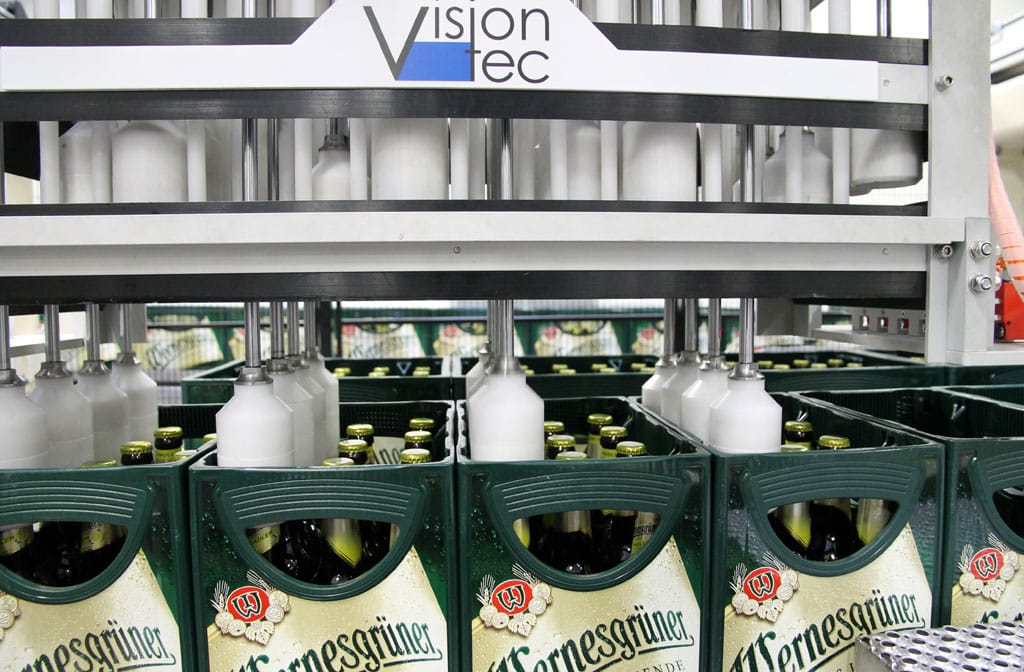
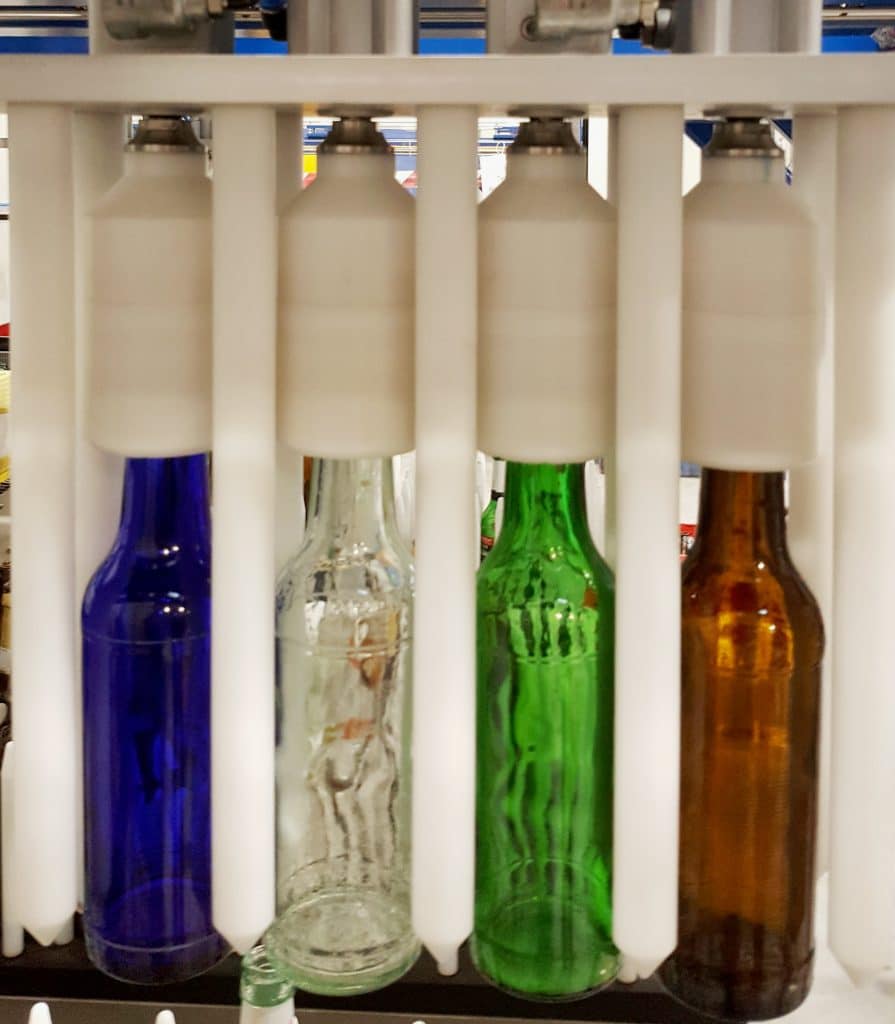
The robot can be scaled or expanded depending on the available space and the task at hand. It consists of several individual sorting stations, each of which has four packing tulips.
Two packing tulips are responsible for removing the wrong bottles, two for inserting the correct bottles. The correct bottle is brought along from the buffer, so that the travel distances are reduced to a minimum.
The wrong bottles are removed and the correct bottles are inserted in the continuous crate, i.e. the packing tulips travel with the crate at the same transport speed. It is not necessary to stop the crates; the speed (and thus also the sorting capacity) remain constant.
The capacity of the sorting robot is approx. 1,200 crates per hour, depending on the expansion level.
The robot can also be equipped with an empty crate infeeder for several crates, so that even non-production or foreign bottles can be collected in the right crate.

As each sorting station is responsible for a maximum of 4 bottles and the packing tulips can move to any position in the crate, crates of different partition types can also be sorted simultaneously. Thus, for example, both 20- and 24-crates (long-side-leading) and 11-crates (short-side-leading) can be moved through the robot. Simultaneous processing of crates with linear compartments and honeycomb compartments is also no problem. With the flexible clamp conveyor, even different crate widths (from 265-305 mm) can be processed simultaneously. No special format parts or conversion work is necessary.
Of course, 0.33 l and 0.5 l bottles can be sorted at the same time. But especially for our customers in the non-alcoholic beverage industry, we have gone one step further: Thanks to the automatic speed adjustment of the cylinders, bottles with a height difference of up to 100 mm (and thus 0.33 l to 1.0 l bottles) can be sorted simultaneously.
With our new sorting concept, where up to 10 bottle types are sorted at the same time, the so-called “empty crate tourism” is avoided. There is one infeed lane for each crate/bottle type to be sorted. The next crate to be sorted is selected on a “target crate basis”. The robot only requests a crate when it has enough suitable bottles for it in the buffer, regardless of which bottles are currently still in the crate. In this way, the bottles in the crate are exchanged directly, without the diversions via separately supplied empty crates.
Realization of multiple tasks with one machine in a small space.
Benefits:
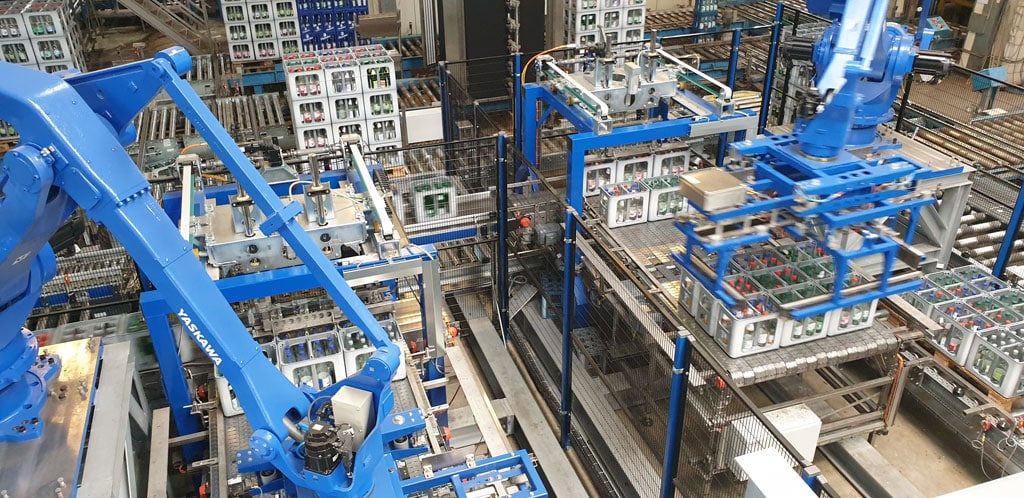
Palletizing (loader, unloader, combined loader/unloader) is performed using jointed-arm robots. Loading/unloading is done layer by layer. The capacity (depending on the task and on the containers to be palletised) is approx. 3,000 cph. Both Euro and industrial pallets as well as half pallets can be processed.
Depending on the task, the unloader is equipped with a row separation station, the loader with a grouping station. The design of the palletizing heads (gripper head, additional hooks for (old) GDB crates, shutter heads, …) varies and depends on the task.
The loading of unmixed pallets can be done (as usual) pallet by pallet or (new and enormously space-saving) layer by layer on several neighboured pallets.
Your sales team